

Monday, June 30, 2014

Monday, March 24, 2014
Vision For Wholemindesign Studio Work
Designing as an act of empowerment: re-imagining professional development for educators
What if…
Teachers are empowered to become designers within their own practice
instead of simply trained to be presenters of content?
What if...
Educational systems acknowledged the individuality, humanity, and artistry within education more fully,
instead of seeking more ways to standardize teaching and learning?
What if...
Professional development meant working collaboratively within on-going cycles of creation, reflection, and revision,
Instead of being left on one’s own, without needed support to launch and develop new ideas?
**********************************************************************************************
As educators we value the uniqueness of every student, and know that the best learning occurs when teachers and students are in collaborative, supportive relationships with one another. We also recognize that deep understanding is best achieved when learners can develop and practice new ideas and skills over time, and in an authentic manner.
When it comes to TEACHERs as learners, however, the opposite is often true. Professional development is sometimes done “to” educators rather than “with” them, and lacks the necessary frameworks to translate new learning into action and deepen a teacher’s capacities. Instead of feeling embedded in “instructional relationships characterized by trust and mutual respect” , educators are too often isolated, feeling overwhelmed with the challenge of trying to make sense of a fragmented practice.
At Wholemindesign we recognize the urgent need to support and nurture the learning process of practicing teachers, so we are asking ourselves:
- How might we reimagine professional development that empowers educators to design authentic solutions to the unique challenges within their practice?
- How can we develop an on-going collaborative community of highly motivated, innovative, reflective, educators who value career-long professional growth?
- How can we create an environment that feeds the “whole teacher” by attending to his personal well-being, and refueling her capacity to create healthy and joyous learning environments for students.
Our answer:
Create a design studio for teachers
What we mean by “studio”
A studio is a place of inquiry where artists and designers prepare for the experience of public performance - a place of rehearsing, making and doing, tinkering, playing, experimenting, and prototyping. A studio is a place for individual as well as collaborative experiences. It is a space to exhibit one’s work-in-progress, get informal and formal feedback, and embrace risk-taking as a step toward developing creative confidence. It is an environment designed for “dynamic cross-pollination and cultured spontaneity”. A studio should function as both a sanctuary and proving ground, protecting and cultivating seedling ideas as they mature, but also challenging one to vigorously wrestle with assumptions and limitations. A studio’s ultimate purpose is to create supporting structures that lead to successful professional practice.
Who comes to the studio
We invite self-motivated educators across disciplines and contexts who want to participate in developing an ecosystem of practitioners devoted to reinvigorating and sustaining the health of their practice, their colleagues’ practices, as well as our profession. Our studio is a de-institutionalized, hierarchy- flattening, multi-directional environment for any educator seeking out resources and community to move their practice forward.
What happens at the studio
We offer a variety of robust studio experiences intended to position educators as vanguards in their schools. By working at the forefront of our profession with the most innovative ideas and practices emerging from research in the field, we aim to provide educators with useful tools to help them function as designers within their practice. In addition to learning new tools, educators will be encouraged to develop the habits of mind necessary for creative work: resilience, perseverance, flexibility, observation, playfulness, patience, and willingness to take risks.
Most studio experiences will be offered for graduate and/or professional development credit (SCECHS). Below is a sample of the kinds of ideas we will explore:
- Educators as Designers: In this studio experience novice through expert K-12 teachers, principals, and administrators from a variety of school systems learn the design thinking process as one tool for functioning as a designer and innovator within their own practices.
- Designing for Deep Thinking: The text, Making Thinking Visible by Ron Ritchhart and Mark Church will serve as the centerpiece for this studio experience. The thinking routines set forth in this book will be the basis of our work together, and educators will use their classrooms as a laboratory to explore these ideas with students.
- Designing for Creativity: The Power of Learning In-And-Through the Arts: This studio experience is for educators interested in exploring frameworks for integrating art and creative thinking into the content areas of language arts, social studies, math, and science.
- Why Wait to Innovate: These studio experiences are opportunities to learn about innovative work being done in the field of education. Guest contributors will be invited to share their work in the form of lectures, presentations, panel discussions, exhibitions, etc. These experiences may last an hour or perhaps a day, depending on the individual contributors.
Each of the above experiences will occur in a yearly cycle of four iterations described below (with the exception of the Why Wait To Innovate Series):
- Exploration: Participants begin their studio experience by exploring one of the topics from above (for example Educators as Designers, Designing for Deep Thinking, or Designing for Creativity). The length of time for this stage will vary depending on the particular topic. Participants then articulate a challenge/opportunity in their practice where they can apply the new ideas and strategies to their own work as an educator.
- Experimentation: Participants experiment with ideas in their own setting using a prototype/feedback model. They are encouraged to fail early and often to succeed sooner as they work on their own design challenge. Educators then return to the studio and “gallery walk” their work-in-progress in order to give and get feedback from one another, and gain inspiration to further develop their work.
- Expeditions: participants engage in site visits and use on-line tools to build on-going connections with each other. This is a time where educators can thoughtfully observe one another at work, collaborate, find support, ask and answer questions, and seek to understand someone else’s practice from the inside out. This stage of the cycle has multiple goals - to enable educators to step outside of their “silos” as an antidote to isolation, to build on-going relationships and supportive networks between practitioners, and to develop empathy for one another.
- Exhibitions: The last stage in the studio cycle is an exhibition of artifacts from the field that make the work on their challenge visible to others. The participant chooses the form that s/he wants to use to highlight struggles and accomplishments across the year such as pictures, narratives, videos, testimonials etc. During this time we celebrate both incremental as well as monumental achievements, and honor the processes and products of our creativity.
GRAPHIC REPRESENTATION OF YEARLY CYCLES
Course offering
(each course would likely be composed of different sets of individuals)
|
ITERATION 1
(typically occurs in summer for 2-3 consecutive days, or during school breaks)
|
ITERATION 2
(typically occurs in fall/early winter on a weekend day or weekday evening(s)
|
ITERATION 3
(typically occurs in mid to late winter - date/time/and extent depends on participants’ schedules)
|
ITERATION 4
(typically in spring or early summer on a weekend day or weekday evening (s)
|
Educators as Designers cycle
|
Exploration
|
Experimentation
|
Expedition
|
Exhibition
|
Designing for Deep Thinking cycle
|
Exploration
|
Experimentation
|
Expedition
|
Exhibition
|
Designing for Creativity cycle
|
Exploration
|
Experimentation
|
Expedition
|
Exhibition
|
The above reflects a small portion of the kind of work we intend for our studio. Our model for growth includes designing further learning opportunities around compelling and promising ideas arising in the field of education. We are open to receiving proposals from other educators who have initiatives they would like to pursue within our studio model of professional development.
Location of the studio
The natural setting of the Wholemindesign Studio for Teaching and Learning is essential to our mission. 

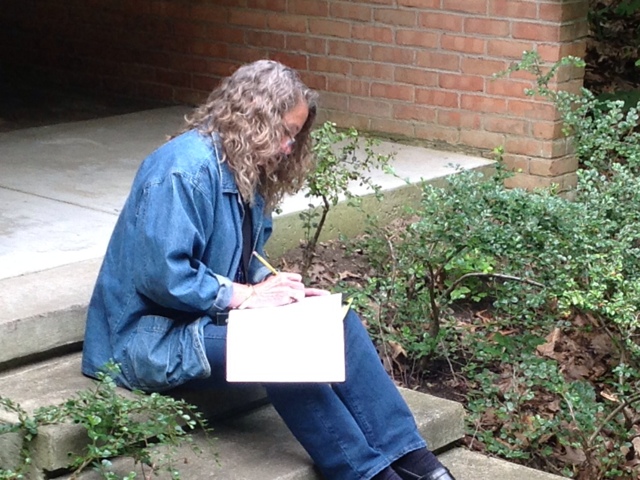 Research has proven that a natural environment heightens concentration, directs attention, and has significant stress-reducing benefits. Additionally, our natural setting is designed to help participants release feelings of fragmentation and disconnection as a step toward building cohesion in their professional lives.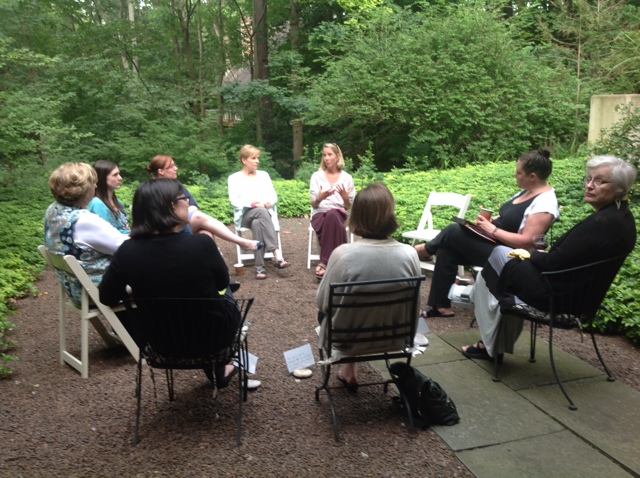
We want our participants to be surrounded with external reminders of the aesthetic we strive to achieve within our practice - deep roots of understanding, appreciation for the diversity of thinking, and a recognition of the beautiful relationship between form and function.
Conclusion
Melanie Kahl and Steve Turckes from the Chicago architectural firm Perkins and Will say studio work is “...a beautiful collection of tensions. There is a constant pull between thinking and doing, the collective and individual...problems and solutions, artistry and engineering. At the heart of this lies creativity.”
Creativity is central to our work at Wholemindesign. We have developed a model for professional development that empowers educators to function as designers and take action within their own practice. Our studio creates opportunities for teachers and administrators across disciplines and contexts to step outside of their usual roles and participate in non-institutional, radical collaborations as a pathway for innovation and professional growth. Our community of highly-motivated, engaged, reflective practitioners shares a commitment to thinking deeply about our work, and values being in sustained conversation with others about the power of education to transform lives. We are professionals who see ourselves as engineers and artists in our classrooms, and continually strive to bring out the beauty of teaching and learning in the lives of our students.
Katrin Oddleifson Robertson
Diane Tamblyn
Thursday, February 27, 2014
changethis.com is a great resource for manifestos from interesting people - their mission is to spread good ideas - here is one (of many!) that I like.
How To Be Creative - a manifesto
How To Be Creative - a manifesto
Saturday, February 22, 2014
Monday, February 10, 2014
Have we crossed into new territory! When colleges and universities begin focusing on certain content, K-12 educators tend to respond. Let's hope this signals a change in how we prepare students for college Creativity as an Academic Discipline. Stay tuned for Wholemindesign's "Why Wait To Innovate" series.
Monday, January 20, 2014
Wednesday, January 1, 2014
Check out our work with the University of Michigan's Ross School of Business!
Images from Wholemindesign's work with Ross School of Business
Images from Wholemindesign's work with Ross School of Business
Friday, October 25, 2013
Saturday, September 28, 2013
Monday, September 9, 2013
http://blogs.hbr.org/pallotta/2013/09/does-your-innovation-come-from.html
This article really grabs me and articulates something about innovation and creativity that I believe deeply. It reminds me of a quote I wrote down when I was in college and discovering the world of creativity. It is from an art critic called Theodore Wolf:
This article really grabs me and articulates something about innovation and creativity that I believe deeply. It reminds me of a quote I wrote down when I was in college and discovering the world of creativity. It is from an art critic called Theodore Wolf:
"On its deepest level,
creativity is a form of love that expresses itself in the urge to
clarify share with others what it holds most dear. It is the expression
of an expansive, curious, and generous spirit, eager to do what it must
to activate, provoke, reveal, or release the fullest aspects of life
and love in itself and in others."
And from the HBR article: "The unspoken assumption is that our goal is to gain competitive advantage, to crush the competition, to win. But I believe that the best creativity comes from a much deeper place than the desire to win. It comes from a desire to contribute to the lives of others, either by introducing something new that improves the quality of their lives or by showing people that something thought to be impossible is in fact possible. When you change people's perceptions about what can be accomplished or achieved, you contribute to their humanity in the richest possible way. You give them hope for the future — a sense that life is not the demoralizing, unchanging drudgery day after day that the world so often teaches us that it is. When you change the way people think about possibility, it is an existential experience. It makes them feel understood."
"I write a lot about philanthropy. Philanthropy means, literally, love of humanity. You don't have to give a million dollars to charity to be a philanthropist. You simply have to actively demonstrate your love of humanity. Your empathy. If the purpose of our creativity is philanthropy — if it is love for our fellow man, an appreciation that people struggle in their lives, and a desire to somehow lessen that struggle and increase their joy, with a little more leg room or with an iPad — it will change the world. And that is the greatest competitive advantage of all."
Saturday, August 24, 2013
This was in Brighton Area School's Newsletter - a little good press never hurts! Design Thinking Training: Earlier this summer, BAS teachers
Jeanne Blazo, Jeri Kay Thomas, Maureen Strachen, Brenda Hurley, and Lisa
Wheeler, along with Hawkin's Principal Pat Meyer attended a three-day, in-depth
exploration of Design Thinking. The premise of the class was rooted in the
fundamental belief that educators should be designers of their own practice and
not merely implementers of programs. The course was created for teachers
and administrators who are working on authentic and engaging learning
experiences while meeting the demands of the required curriculum. As part of
their collaborative work, site visits were made to Google Headquarters in Ann
Arbor.The course participants are excited to continue exploring the Design
Thinking process within their own buildings and classroom experiences. The
course was offered through the Wholemindesign Studio for Teaching and
Learning and was led by Katie Robertson and BAS Kindergarten teacher Diane
Tamblyn.
Friday, August 23, 2013
Hello designing friends,
This looks like a fantastic opportunity - getting to spend 2 weeks at an IDEO site is very exciting. Let us know about your experience if you are able to go.
Very cool opportunity!
This looks like a fantastic opportunity - getting to spend 2 weeks at an IDEO site is very exciting. Let us know about your experience if you are able to go.
Very cool opportunity!
Friday, August 16, 2013

Monday, August 5, 2013
Wonderful class!!!
We had an extraordinary time in our class, Educators as Designers, last week! Thank you to all of those who made the experience so special. We are looking forward to planning 2.0. Watch our website for more details.
Tuesday, July 23, 2013
This looks like an interesting conference for those interested in teaching design.
http://www.eventbrite.com/event/6787729281/
http://www.eventbrite.com/event/6787729281/
Monday, July 15, 2013
Monday, May 27, 2013
Monday, May 20, 2013
Sunday, May 12, 2013
There is new research that supports the idea of movement and touch (aka wholemindesign's mobile mapping process) as a powerful way to learn. They are calling it "embodied cognition". Here is a link to an article describing this concept
http://www.edweek.org/dd/articles/2013/02/06/02bits-cognitive.h06.html.
http://www.edweek.org/dd/articles/2013/02/06/02bits-cognitive.h06.html.
Tuesday, May 7, 2013
Hello friends,
Here is a link to a podcast I was interviewed for recently about the importance of arts integration in schools.
Here is a link to a podcast I was interviewed for recently about the importance of arts integration in schools.
http://5044.podomatic.com/entry/2013-05-06T20_41_00-07_00
Subscribe to:
Posts (Atom)
